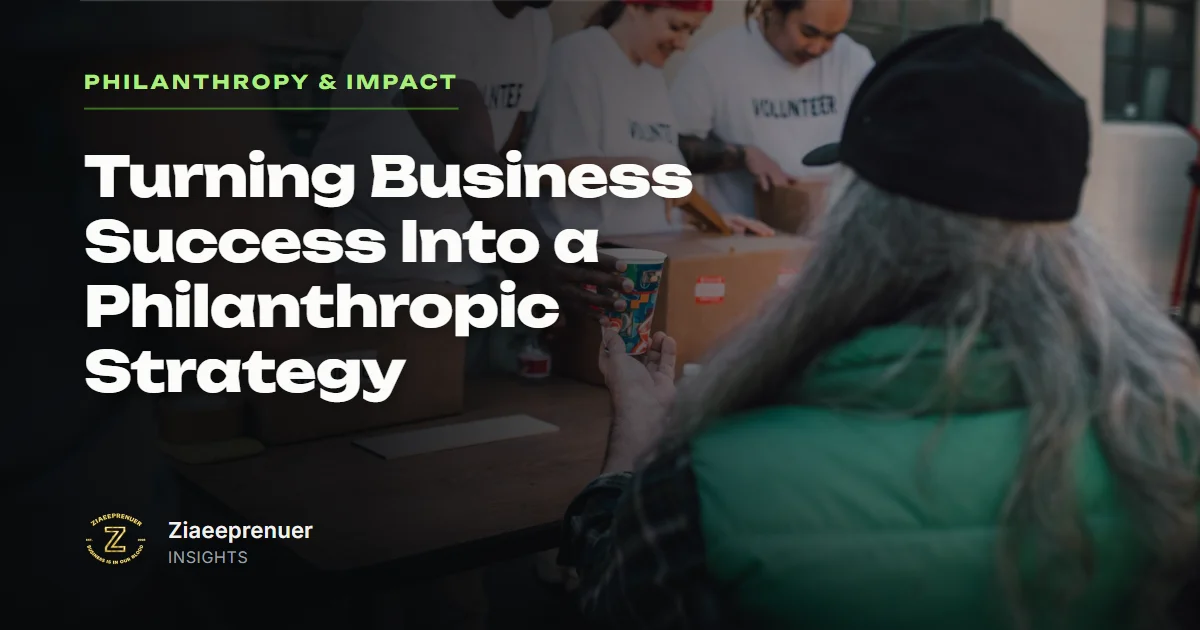
For most successful founders, giving starts reactively: a cause someone asks
about, a cheque written because saying no feels wrong. That's not a criticism —
it's the default path when there's no deliberate strategy behind it. But the same
operating discipline that built the business rarely gets applied to what happens
with the success it produces, and philanthropy without that discipline tends to
stay scattered no matter how much capital moves through it.
Three questions separate strategic contribution from reactive giving.
What specific outcome are you actually trying to create?
"Help people" isn't a strategy, it's a sentiment — it can absorb unlimited capital
without ever being satisfied or measured. A bounded, specific goal can be
evaluated, adjusted, and eventually judged to have worked or not. The shift from
sentiment to outcome is the same shift that turns a business idea into a business
plan.
What can you contribute beyond money?
Capital is the easiest resource to give and often the least differentiated —
plenty of donors can write a cheque. A founder's network, operating expertise, and
platform are usually scarcer and harder to replace, and often move the needle
further than the money alone.
What's the multi-year commitment, not the one-off gift?
Durable impact is built the same way durable businesses are: through sustained
commitment, not a single transaction. A cause worth backing is usually worth
backing for years, with a structure — a foundation, a standing partnership, a
recurring commitment — built to outlast any one good year.
This is close to what came up in our Legacy
Contribution engagement with a retired chief executive: after a successful
exit, there was capital but no vehicle for meaningful impact, and no structure to
turn intent into something lasting. The work wasn't deciding to give — it was
identifying the causes genuinely aligned with the client's values and building a
structure built to carry that forward. Treated with the same rigor as the business
that funded it, philanthropy stops being an afterthought and becomes part of the
legacy itself.